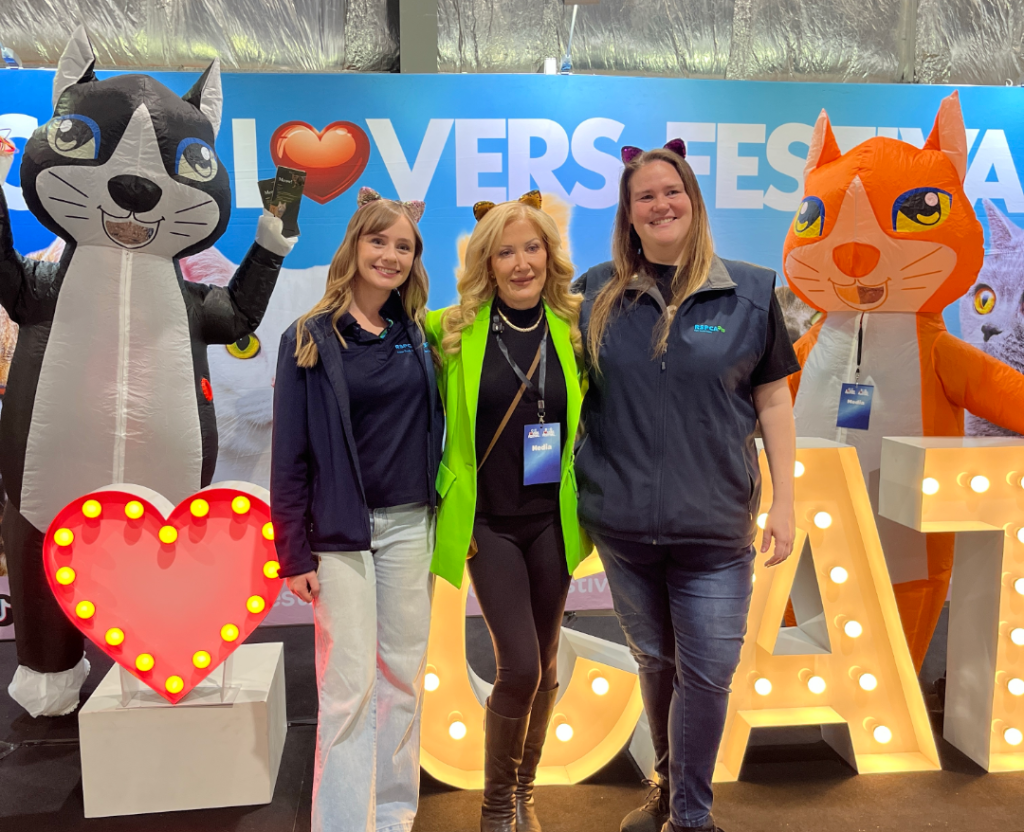
As Sharon celebrates 20 years with RSPCA NSW, we chatted about her amazing journey with the organisation and the many different badges she’s worn over the years!
Thank you, Sharon, for your many years of service and the countless animals and people you’ve helped along the way.
Can you believe it’s been 20 years since you started working with RSPCA NSW?
To be honest, it doesn’t feel like 20 years, it’s just gone so fast – as do many years when you think back to it. Definitely been a journey!
What led to your first role with the organisation?
I used to work in a production factory, I left there to have children and after my children hit school age, I wanted to go back to work. I wanted to do something meaningful and to give back to the community. I have a big affinity with animals, as many people do, so I was like, I might go volunteer at the RSPCA. I started volunteering there at the Hunter Shelter and as they say, the rest is history.
I started as an Animal Attendant and just worked my way up. I took a photo years ago of all the badges that I had with all the positions that I’ve held within the organisation since I’ve been with it and it still blows people away. It just showcases what you can do within this organisation. There are so many places that you can expand and go into. You’re not just stuck in one department and that’s one of the things I love about the RSPCA; there’s so many pathways that open up for you.
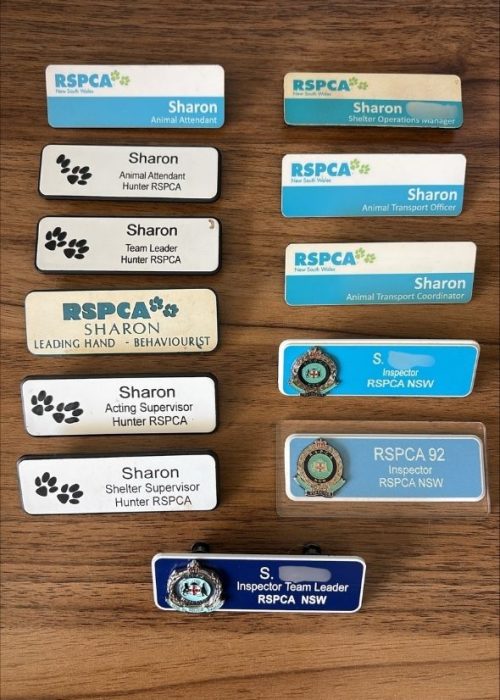
All of Sharon’s badges over the years.
You’ve been part of our Inspectorate for several years now, what drew you to the position?
I really took an interest in animal behaviour and absolutely loved that. That position actually is what sparked me wanting to be an Inspector because once the animals were already in the shelter, there wasn’t anything we could do but deal with the behaviours in the shelter and the animals in the shelter. But I was like, how do we stop some of these animals coming in? I realised you really need to be on the outside.
I started working with some of the Inspectors and I was like; this is where I want to be. I want to be out there to try and help, be proactive and prevent some of these animals that don’t necessarily need to come into the shelter. So, I just started working towards that and doing everything I could to try and get the skill set to be able to do that. That journey took me a while, but I was able to build skills along the way which helped me in my role now.
How has the role of an Inspector changed over the years?
I think we’ve come a long way, even from when I first started seven years ago as an Inspector to where we are now. We have so many resources now available to help these people and sometimes it is just education and helping people understand that we have a standard that these animals need to be cared for, a standard of welfare and helping them achieve that.
I love being able to help people and understand them because the way I look at it is if I seize an animal, they can just go out and get another one and they really haven’t learned anything. But if there’s no detrimental immediate worry for the animal’s welfare and I can educate them and they’re not being cruel, they just don’t understand how to care for the animal. If I can educate them, one, I’ve stopped that animal coming into our care, into a shelter environment, which we all know is not great for any animal. Two, I’ve educated them to be able to lift up the standard of welfare for that particular animal, but also when that animal is no longer with them, they’ve already got all that knowledge to be able to care for that next animal. So, I love being able to educate people.
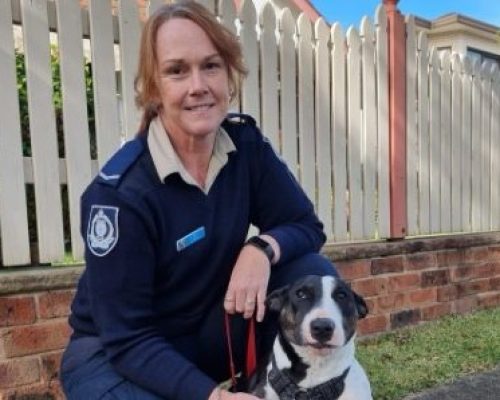
Sharon with one of the many animals she’s helped as an Inspector.
Are there any jobs over the years that have really highlighted the positive impact you can have for people and their animals?
The one that always stands out was an older gentleman in the Newcastle area. His animal was quite skinny. He felt that he was doing the right thing but didn’t understand about worming an animal. He was quite combative when I first went there because he just saw me and thought I was going to take his cat. This cat was all he had; it was just him and this cat living in this unit.
The cat was 10 years old; it was quite skinny and when I spoke to him, I said, “I’m not here to take your animal. That is not my goal. My goal is to help you help the animal. So, what can we do to come together?” We started talking and I said to him, “What are you feeding it?” and the feeding had seemed fine. And I said, “When did you have a vet check last?” It had never been to a vet. Then I said to him, “What about worming?” and he didn’t know what that was or how to do it.
It was just so basic and something we obviously all take for granted but he just never realised that he should worm his cat. So, I gave him some worming treatment that I had in the car that I carried with me, and I showed him how to worm the cat. I organised a check-up at our Hunter Vet Clinic and it was a healthy cat, just underweight. So, I gave him some time and in two weeks the cat did start to put on weight, and it was just the worms.
So, helping him understand that, he continued to worm it, and he still calls me to this day, five years on, if he has a question or if he wants to report people for not doing the right thing with their animals. He sadly lost his job about two years ago and he was struggling so he rang me to see if there was anyone that could assist. I said, “What do you need?” and he said, “I just need some food for my cat”. So, I dropped off food for him, and he now goes around and spouts how great the RSPCA is. So that one always sticks with me.
What are some of the biggest challenges working as an Inspector?
I think society is very quick to judge, and I understand it is hard. They see a skinny animal or an injured animal, and they just assume it’s being ill-treated. But sometimes it’s just the people don’t understand. They need education or it could be they’re having a bad moment, and they just need a little bit of help to get them through.
I think because of the uniform we wear, we obviously look like someone in an authority position and people get their backs up at us straight away and they have this preconception that RSPCA inspectors are just going to take everything, and I just wish they had the same understanding that we did. Like we’re not judging them and we would like them to not judge us and just hear us out and not come out the door yelling at us. That would be nice.
We aren’t just out there seizing animals and prosecuting people. There are so many jobs where we can actually make a difference in an animal’s life without seizing it. There are so many things that we can be out there doing and being proactive and if we see something, we can fix it before it gets to the point where we have to seize it.
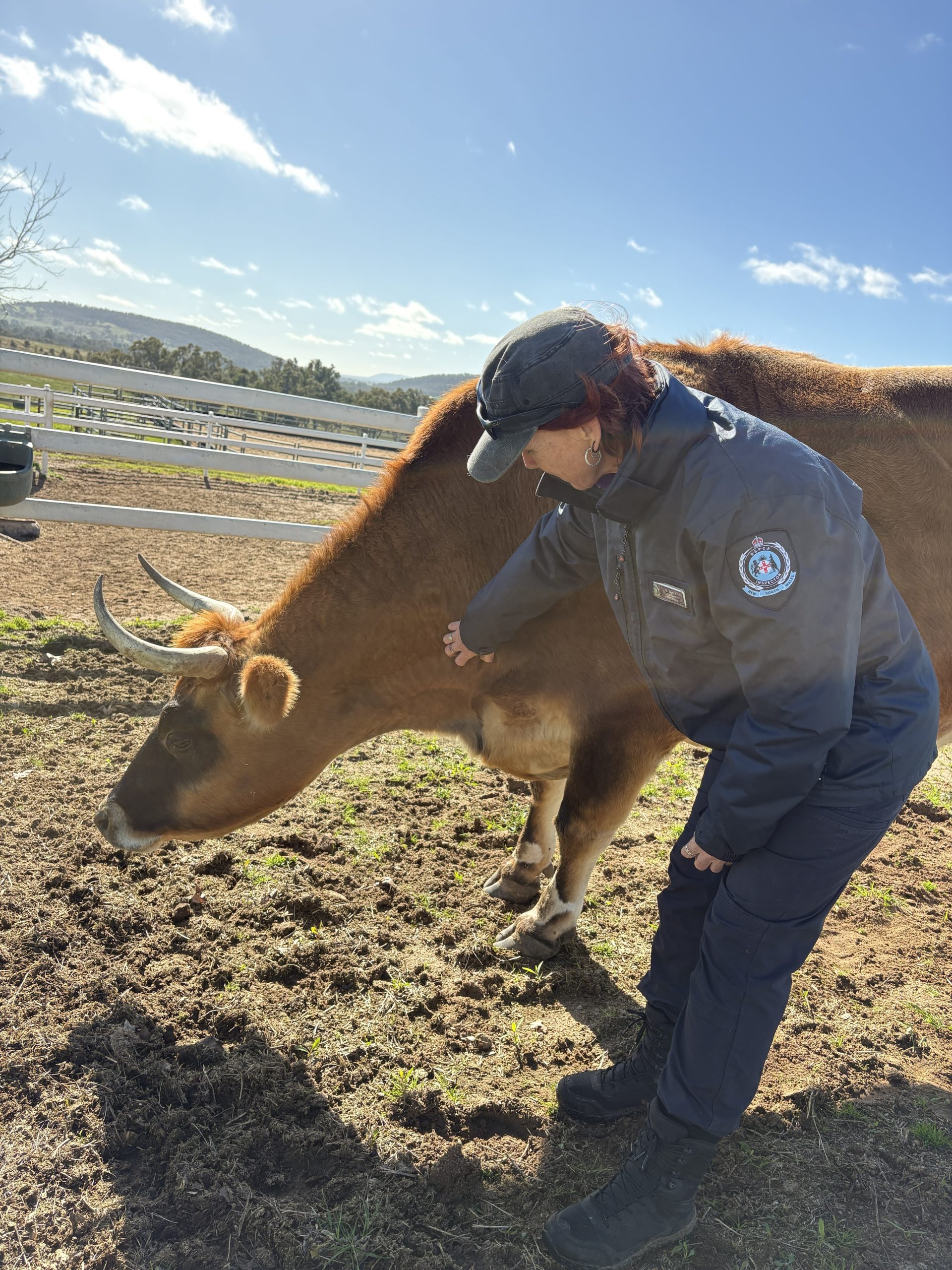
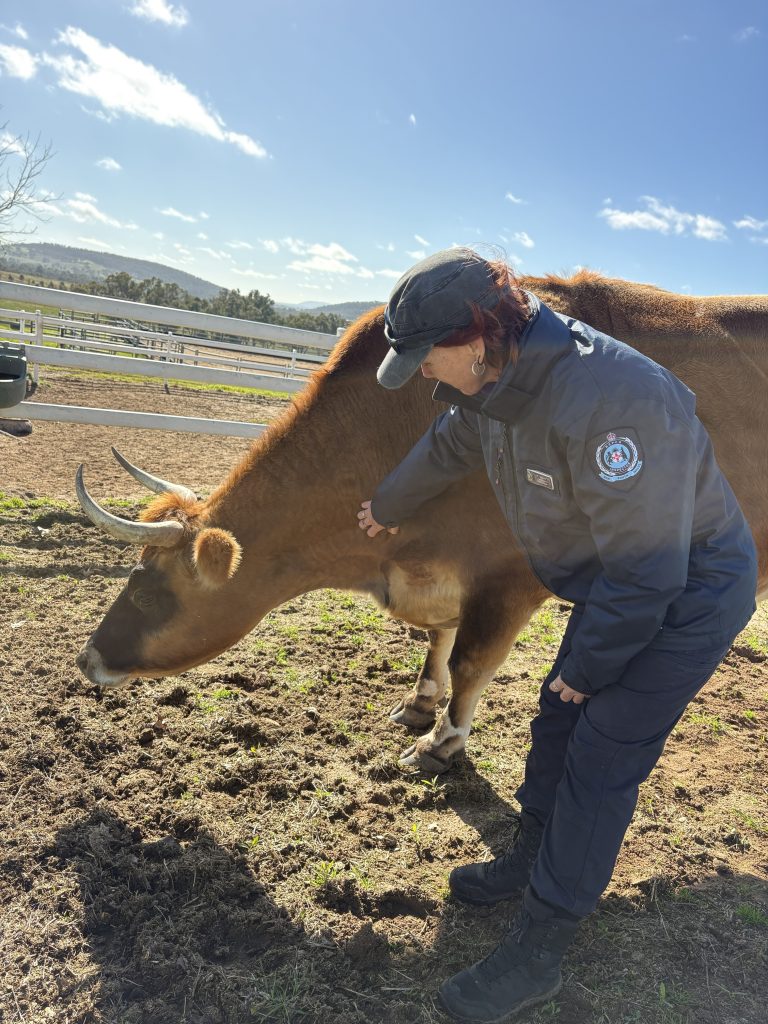
Sharon meeting some cattle out in the field.
Your current position is Inspector Team Leader for the Central Region, a massive area to cover with stretched resources, how do you keep everyone motivated?
We’ve got a really good tight knit group, we’re very like-minded and we’re all about the animals and just getting our job done and doing what we can in the time that we’ve got. We just try and keep each other upbeat and because we’re all spread out, we give each other phone calls. Every Monday I do a team catch up with them and we do that via Teams, so we all get to see each other and have a coffee in the morning before everyone starts and just have a bit of a chit chat.
I’m very much a glass half full type of person, not a glass half empty and every day is a new day. It doesn’t matter how bad today is, it’s not going to last forever. Tomorrow’s a new day.