A Wollongong man has been found guilty of committing an act of cruelty after repeatedly smacking his Staffordshire Terrier puppy as a form of punishment.
Appearing in Wollongong Local Court on 4 June 2026, the defendant was convicted and handed a $1500 fine. They were also given a two-year disqualification order that prohibits the defendant from owning or having anything to do with the keeping or care of animals. The defendant must also forfeit all animals in their care. Animal care costs were awarded to RSPCA NSW totalling $3,404.54 along with professional costs $117.
In March 2026, RSPCA NSW received an audio recording of the defendant yelling at their puppy along with slapping sounds followed by crying and yelping by the dog.
An RSPCA NSW Inspector subsequently attended the property with no one home at the time and the puppy was seized for veterinary assessment.
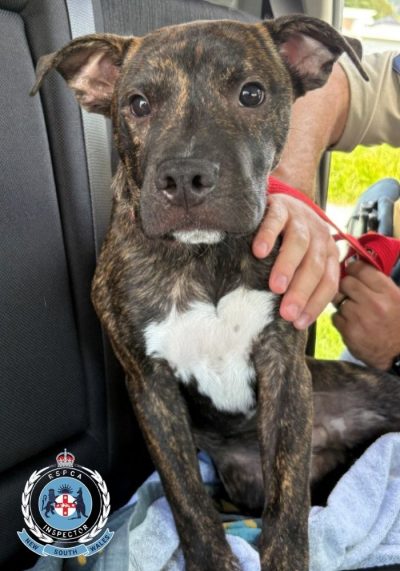
The following day, the Inspector returned to the defendant’s property for a formal interview.
The defendant confirmed he owned the puppy with his fiancée and that he smacks and yells at the puppy as a form of discipline for urinating and defecating inside the house.
In relation to the recorded incident, the defendant said he had smacked the puppy for defecating inside the house before chasing him outside and smacking him a further four times. He confirmed the puppy heard yelping in the recording was his, and that he didn’t believe he had done anything wrong.
During the interview, the defendant also admitted that he has grabbed and smacked the puppy “heaps of times”.
While a veterinary examination of the puppy found no physical signs of injury or sickness, the audio recording was provided to an RSPCA NSW veterinarian, who noted:
- The dog vocalised in distress at a high-pitched frequency
- Striking/thumping sounds heard approximately 25 times within very quick succession
- From the amount and intensity of vocalisation, the dog was clearly distressed
Georgie Caspar, RSPCA NSW Senior Manager of Animal Care, stressed that such actions can have serious consequences and often make toilet training more difficult.
“Punishing a dog or puppy for toileting in the house is not only inflicting pain and distress, but it can also make the problem worse, not better,” Georgie said.
“Punishment like yelling, growling or slapping is frightening and threatening.
“Puppies, and all animals, can associate this type of treatment with the person, the environment and whatever is around them at the time. It can lead to fear of people, reduced confidence generally or even defensive behaviours in anticipation of fear and pain.
“In fact, in terms of learning, the dog is more likely to avoid people in future and not toilet in front of them. This makes it very difficult to change the behaviour and show them where you would like them to go instead.”
RSPCA NSW advocates for training approaches that set puppies up to be safe, well-adjusted companions in the long term.
Training or learning for animals should support positive welfare and emotional wellbeing. It should align with modern and evidenced based approaches that reduce the risk of defensive behaviours that could be potentially unsafe for people and lead to poor welfare outcomes for animals.
Reward-based training is proven to be enjoyable for dogs and positively enhances the human-animal bond. Rewards can be given in the form of a favourite food, toys or verbal praise delivered in a pleasant tone of voice.
Reward-based training is the most humane and effective way of training dogs and addressing any unwanted behaviours.
More information about how to raise a healthy and happy puppy can be found here.
RSPCA NSW would like to remind the community that if you have any concerns about an animal’s welfare, please call our cruelty hotline on 1300 278 3589 or 9770 7555.